
Agentic AI Can Complete Tasks. But Can It Build Trust?
In Short
Agentic AI automates tasks. Emotional intelligence in AI understands people. These are not competing concepts, they are complementary capabilities. Organisations that combine autonomous action with emotional understanding will outperform those that treat efficiency as the only metric that matters.
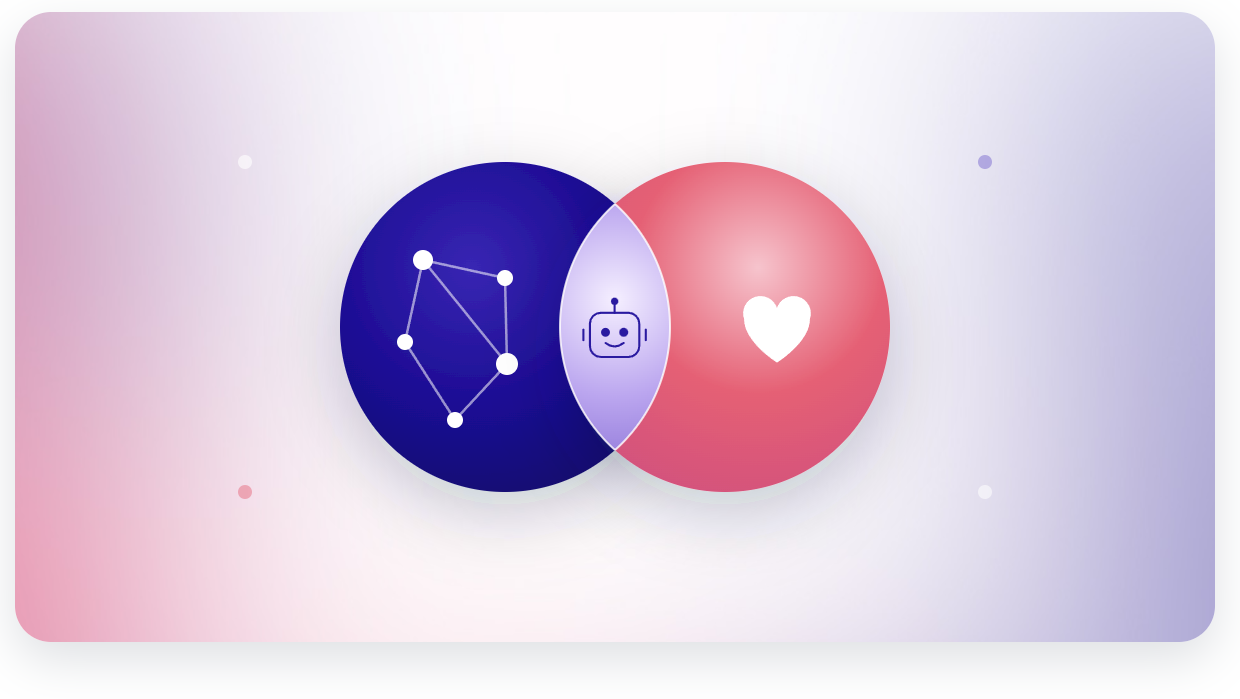
Agentic AI and emotional intelligence in AI as complementary capabilities
When Agentic AI Is Not Enough: Why Emotional Intelligence Is the Missing Layer
Agentic AI is quickly becoming the defining trend in enterprise artificial intelligence. Organisations are investing in AI systems that can reason, make decisions, and execute complex tasks with minimal human intervention. These capabilities are transforming how businesses automate processes and improve efficiency. But when AI is responsible for interacting with patients, students, or customers, completing a task is only part of the equation. The quality of the interaction, whether a person feels understood, reassured, and confident, can shape outcomes just as much as speed or accuracy. That's why the next evolution of enterprise AI isn't just about greater autonomy. It's about combining agentic capabilities with emotional intelligence to build conversations people can trust.
Which AI Understands Emotions in Customer Conversations?
AI systems that understand emotions go beyond sentiment analysis. They detect hesitation, low trust, and disengagement in real time and adapt their responses accordingly. Platforms built on psycholinguistic frameworks, such as our SymantoAssist, combine NLP with computational psychology to identify not just what a customer says, but what they mean emotionally.
What the Problem Actually Costs
The dominant conversation in enterprise AI is about efficiency. But the outcome that determines long-term performance is trust, whether the person on the other end of the conversation felt heard, understood, and confident in the next step.
Imagine two AI systems.
Both answer within seconds.
Both provide accurate information.
Both complete the requested task.
Only one notices that the customer has asked the same question three times because they're uncertain, not because they didn't understand the answer.
Which conversation builds trust? The difference may seem subtle, but it has a measurable impact on trust, loyalty, and business outcomes. Research consistently shows that how people feel during a conversation often matters just as much as whether their question was answered:
60% of customers leave not because a problem went unresolved, but because they felt ignored (Salesforce, 2024)
89% of patients cite poor communication quality as the primary reason for switching providers (Accenture Health, 2023)
87% of consumers report greater loyalty to brands with fast and empathetic support, speed alone does not drive retention (Zendesk, 2025)
In healthcare especially, the details that don't make it into the CRM are often the ones that matter most, whether a patient seemed nervous, hesitant, or close to giving up. An AI that carries that emotional context forward is where the real value lies.
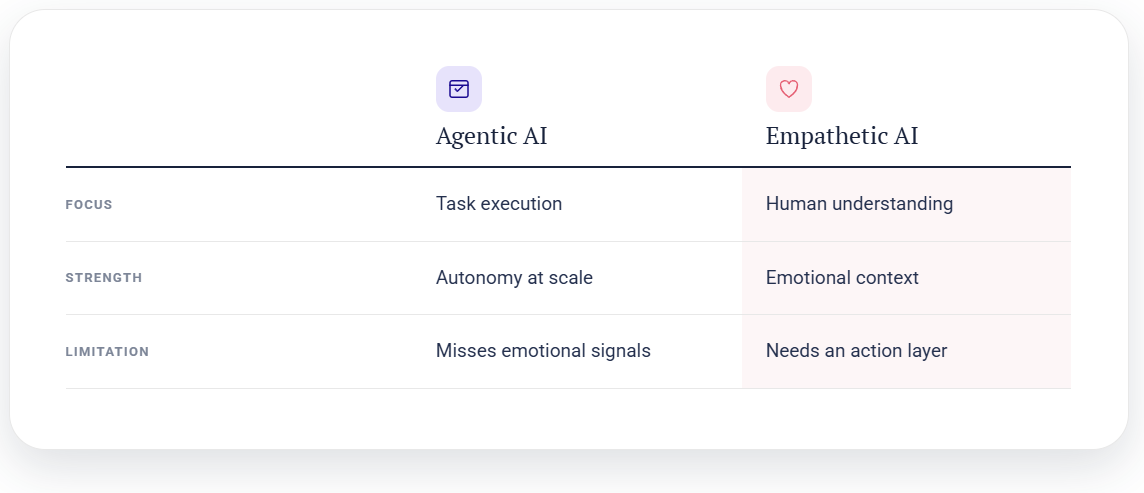
Comparison of agentic and empathetic AI
SymantoAssist
Solving this requires more than a better chatbot. It requires a multi-agent architecture where specialized AI agents work in concert, each contributing a layer of understanding a single model cannot provide alone.
SymantoAssist processes every conversation across four simultaneous layers:
Intent: what the user needs done
Emotion: how the user is feeling, and how that should shape the response
Memory: what was said and felt in previous interactions
Escalation: when a human should take over, and with what context
Cognitive Transformation
Efficiency gains are real. But they are not a transformation.
Cognitive transformation is what happens when AI changes not just how an organization operates, but how it thinks, how it understands its customers, responds to their needs, and builds relationships that compound over time.
This requires emotional memory that builds across interactions, psychological depth beyond keyword matching, and human-AI collaboration that makes teams smarter about the people they serve.
That is the category we from Symanto are working to establish. Not AI that automates. AI that understands.
Frequently Asked Questions
-
Agentic AI autonomously plans and executes multi-step tasks. Empathetic AI detects and responds to human emotional states during conversation. They are complementary: agentic AI handles what needs to happen, emotional intelligence handles how it is communicated.es here
-
Research shows 60% of customers who leave do so not because a problem went unresolved, but because they did not feel heard. AI contact centers without emotional intelligence optimize for efficiency while eroding trust, the opposite of the intended result.
-
Standard sentiment analysis classifies text as positive, negative, or neutral. Our models are trained on psycholinguistic frameworks, capturing indirect, culturally variable, and personality-driven expressions of emotion that standard models miss.
-
Cognitive transformation is the shift from using AI for process automation to using AI to fundamentally change how an organization understands and responds to the humans it serves, building emotional memory, adapting to communication styles, and making human teams smarter over time.