
GDPR and AI Contact Centers in 2026: What European Companies Need to Know
The market for AI-powered customer service is consolidating rapidly. US hyperscalers are building healthcare-specific AI platforms. Enterprise conversational AI vendors are raising capital at multi-billion-dollar valuations and expanding into regulated European markets.
For European companies in healthcare, higher education, or financial services, this raises an important question: as vendors grow, consolidate, or change ownership, does your GDPR compliance posture remain intact?
At Symanto, we combine psychology research with conversational AI, built on EU infrastructure by default, with GDPR compliance embedded in the architecture rather than added as a feature. This post examines what that difference means in practice, and what any European organisation should evaluate when selecting or reviewing an AI contact center vendor.

European AI contact centres operate across a patchwork of national data regimes — GDPR sets the baseline, but compliance means more than ticking boxes.
Why 2026 Changes the GDPR Landscape for AI Contact Centers
GDPR has been in force since 2018, but the compliance landscape for AI systems in customer service looks materially different in 2026.
The EU AI Act: High-Risk Classification for Emotion AI (August 2026)
From August 2026, AI systems that detect or infer emotions in professional contexts are classified as high-risk under Chapter III of the EU AI Act. This applies to sentiment analysis, tone detection, and psychological signal recognition. Obligations include conformity assessments, technical documentation, human oversight mechanisms, and registration in the EU high-risk AI database.
Our platform SymantoAssist combines psychographic and emotional signal analysis with a design focused on transparency, human oversight, and accountability, including audibility, clear escalation pathways, and governance processes built into the platform from the outset.
The European Health Data Space (EHDS)
The European Health Data Space (EHDS), in force since March 2025, introduces a new framework for the secure access, exchange, and use of electronic health data across the EU. Healthcare organisations evaluating AI solutions should consider how vendors support evolving European requirements around health data governance, security, interoperability, and regulatory accountability.
Vendor Consolidation and Contractual Continuity
When a vendor is acquired, the DPA governing your data, the sub-processor list, EU data residency configuration, and contractual notification obligations can all be disrupted. These require active monitoring, not passive assumption.
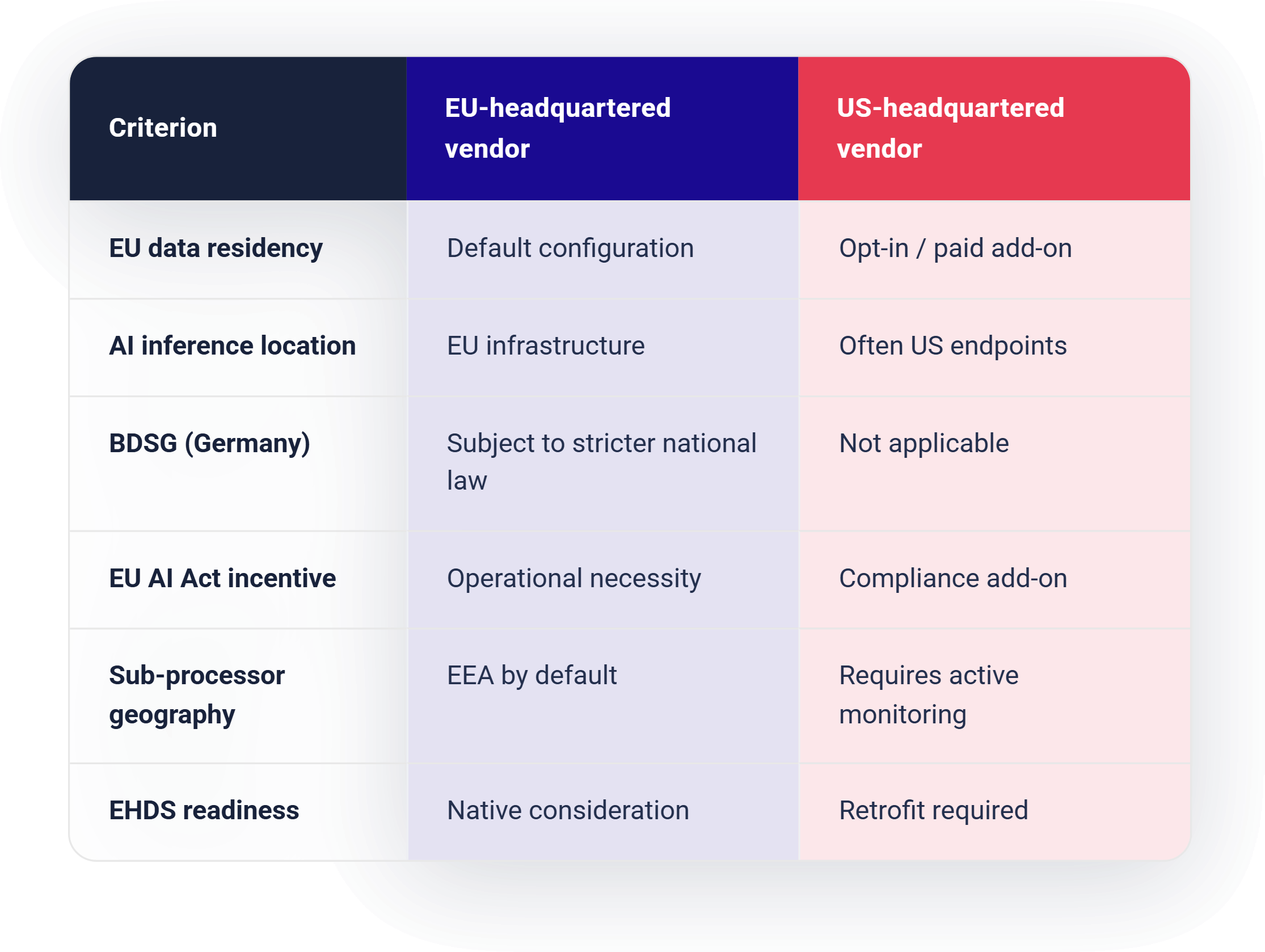
The table summarises the structural differences between EU-headquartered and US-headquartered vendors.
We from Symanto operate entirely on EU infrastructure, are subject to German BDSG requirements in addition to GDPR, and process all AI inference, including emotional signal recognition, within the EEA by default.
What Genuine GDPR Compliance Requires
1. EU Data Residency as Default, Not Opt-In
With opt-in EU hosting, it is easy for configurations to drift, for new features to route data through non-EEA endpoints, and for sub-processors to operate outside the EEA. EU-headquartered vendors operate EU infrastructure as the default.
2. AI Inference Stays Inside the EU
Storing customer data in Frankfurt while routing it to a US-based language model for inference does not constitute EU-only data processing. AI inference must also occur on EU infrastructure.
3. A Substantive Article 28 DPA
Under GDPR Article 28, processors must provide sufficient guarantees about technical and organisational measures. Request the full sub-processor list and ask how sub-processor changes are notified.
4. EU AI Act Classification Transparency
Any vendor offering emotion detection or psychological profiling is in the high-risk AI category from August 2026. Ask whether they have conducted a conformity assessment and whether they are registering in the EU high-risk AI database.
5. Special Category Data Handling for Healthcare
Health data is special category data under GDPR Article 9, requiring explicit legal bases and higher technical safeguards. Ask specifically about data minimisation, pseudonymisation, access controls, and production experience with Article 9 compliance.
Frequently Asked Questions
-
Several vendors offer GDPR-compliant configurations, but depth varies. We from Symanto have EU data residency as a structural default and are subject to stricter national data protection laws including the German BDSG. US-based platforms offer EU regions as configuration options but require active governance. For regulated sectors, EU-native vendors present lower compliance risk.
-
A GDPR-compliant vendor meets minimum legal requirements: DPA, lawful processing basis, data subject rights. A GDPR-native vendor was built in the EU regulatory environment, where GDPR is the default operating condition rather than a compliance layer added to a US-architected product. The difference matters for audit readiness and the ability to respond to regulatory changes quickly.
-
Yes. From August 2026, AI systems that infer or detect emotions in professional contexts are classified as high-risk under the EU AI Act (Annex III). This applies to sentiment analysis, tone detection, and psychological profiling in customer interactions. Our SymantoAssist was designed with these requirements in mind — real-time psychographic profiling is a core capability, not an add-on, so the compliance infrastructure is built in.
-
Evaluate: (1) EHDS Regulation readiness for national healthcare data requirements. (2) GDPR Article 9 compliance for special category health data. (3) EU AI Act high-risk readiness for emotion detection. (4) EU data residency for AI inference, not just storage. (5) References from EU healthcare customers in production under GDPR. We from Symanto are headquartered in Germany and address all five by default.
-
Acquisitions can disrupt the DPA, sub-processor list, EU data residency configurations, and contractual notification obligations. Data Protection Officers should review vendor contracts when an acquisition is announced, request updated DPAs and sub-processor lists, and assess whether the acquiring entity's architecture is compatible with existing data residency requirements.
-
1. Is EU data residency the default, or does it require activation?
2. Where does AI model inference happen - inside or outside the EEA?
3. Has your platform been assessed under the EU AI Act high-risk provisions (August 2026)?
4. What is your process for notifying us of sub-processor changes?
5. Do you have a published Article 28 DPA with a named, current sub-processor list?
6. Do you have EU healthcare or higher education customers in production under GDPR?