
The short answer
The market research industry is mid-pivot from AI-assisted workflows to agentic ones, where an AI system formulates questions, analyzes data, and delivers findings, with the researcher supervising rather than executing every step. The organisations that will lead are not those using more AI. They are those using AI designed for the full arc of insight generation, not just the first question.
What is agentic AI in market research?
Agentic AI in market research refers to AI systems that run multi-step research workflows end-to-end: formulating the right questions, selecting data sources, conducting analysis, and synthesising findings into actionable insight, rather than responding to a single prompt. Unlike general-purpose chatbots, agentic research systems are embedded in existing workflows, operate with domain-specific understanding, and produce auditable outputs that withstand leadership and compliance scrutiny.

The leadership-practitioner gap in research AI adoption reflects a structural problem, not a people problem. When 72% of leaders believe research impact is rising but only 44% of individual contributors agree, the most likely explanation is that the AI being used accelerates tasks without transforming the insight-to-decision workflow. Agentic systems address this by removing the human coordination layer between research steps.
The gap that efficiency metrics cannot see
Nearly every market research team in 2026 is using AI. Ninety-five percent of researchers now use it regularly or are experimenting with it (Qualtrics Market Research Trends Report, 2025). The question of whether AI belongs in research has been settled. What has not been settled is whether the AI they are using was designed for research.
There is a quiet perception gap opening inside insights organisations. Seventy-two percent of C-suite leaders say their organisation relies on research more than a year ago. Only 44% of individual contributors agree. Eighty-three percent of leaders say AI has made their teams more efficient. Just 65% of the people doing the actual work feel the same way (Qualtrics, 2025).
Leadership sees momentum. The people closest to the data feel stretched, not accelerated.
That gap is not a morale problem. It is a signal that the tools being used to close the distance between "we have data" and "we understand our customers" have not kept up with the ambition — because most organisations are still using AI one prompt at a time, with a human stitching the steps together.
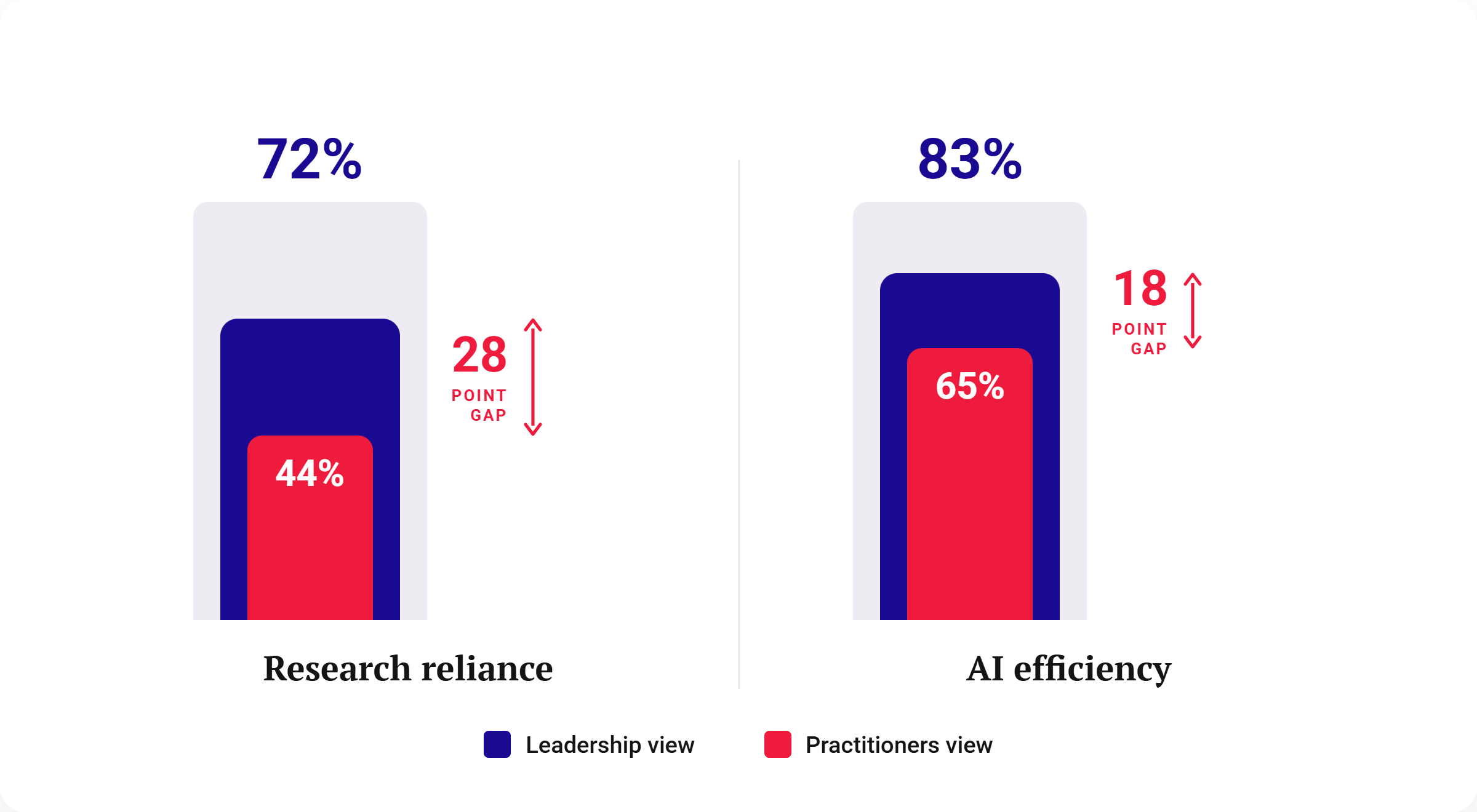
The leadership-practitioner gap in research AI adoption reflects a structural problem, not a people problem. When 72% of leaders believe research impact is rising but only 44% of individual contributors agree, the most likely explanation is that the AI being used accelerates tasks without transforming the insight-to-decision workflow. Agentic systems address this by removing the human coordination layer between research steps.
Why general-purpose AI has a structural ceiling
The adoption data tells the story. Use of general-purpose AI and chatbots for research dropped from 75% to 67% between 2024 and 2026. Use of AI embedded in research platforms rose from 62% to 66% over the same period (Qualtrics, 2026).
Researchers are not abandoning AI. They are abandoning AI that requires them to remain the connective tissue between every step. The difference between a tool that speeds up one task and a system that owns the full workflow is not a matter of degree. It is a matter of architecture.
The academic community has started formalising this distinction. InsightBench, published at ICLR 2025, tested AI agents on 100 business datasets with insights deliberately embedded. The benchmark asked not whether an AI could answer a given question, but whether it could determine which questions were worth asking and then answer them end to end. When academics build benchmarks for a capability, it has moved from demonstration to discipline. The question is no longer whether AI can answer, it is whether AI can research.
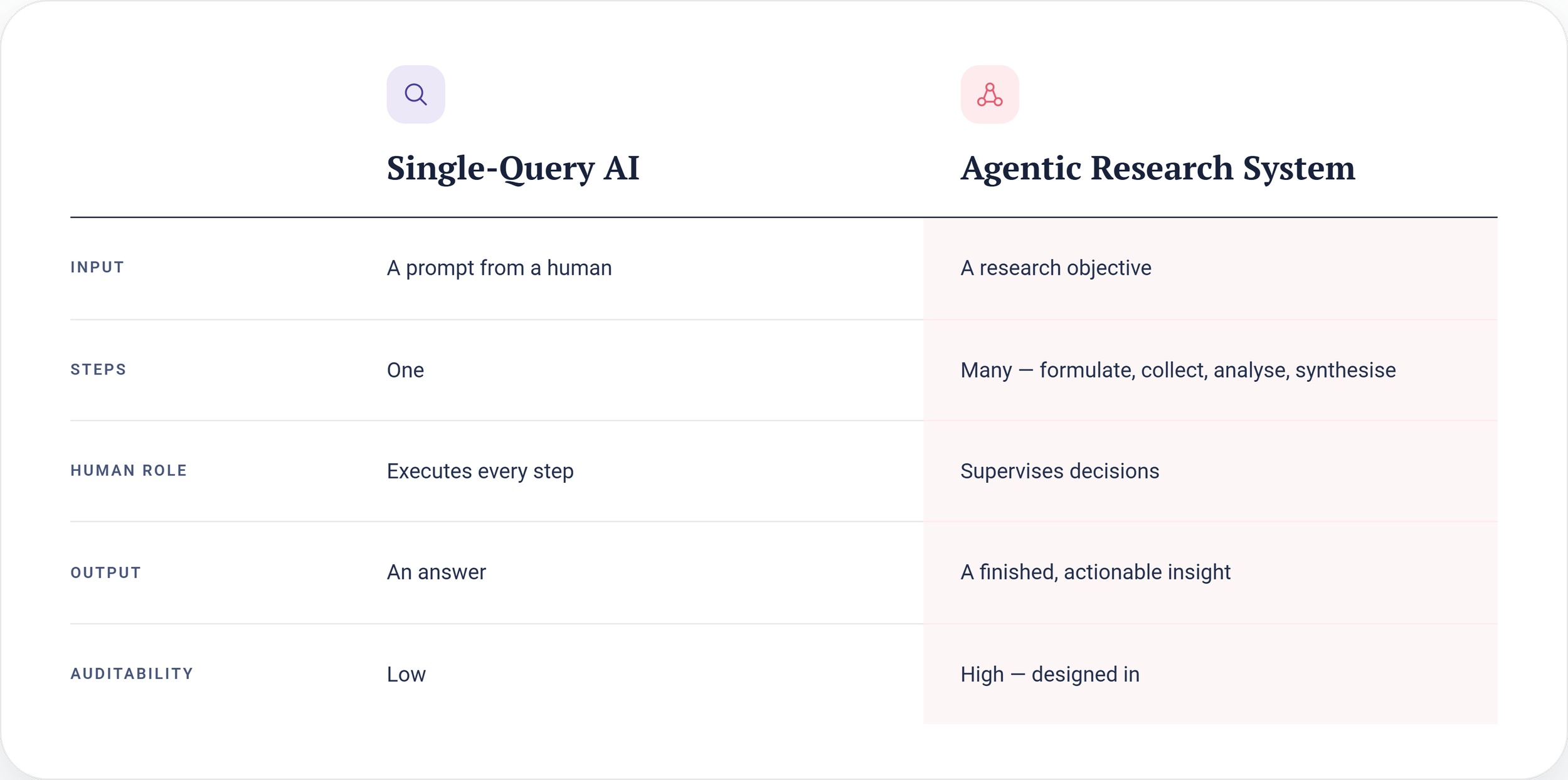
General-purpose AI tools require the researcher to remain the connective tissue between every step of the workflow. Agentic research systems, embedded in research platforms and built to run multi-step workflows with a human in a supervisory role, eliminate that overhead. The Qualtrics data shows adoption already shifting in this direction, with embedded research AI rising and standalone chatbot use declining.
The architecture the next research team runs on
The competitive landscape has moved quickly. Forsta launched purpose-built research agents claiming 50% faster time-to-insight. HeyMarvin built a multi-agent system that cross-validates findings across enterprise research repositories. Deloitte released a four-agent Customer Insights Suite on AWS. Adobe embedded a Data Insights Agent directly in Customer Journey Analytics.
The category is not emerging, it has arrived.
At Symanto, we have been building toward this for fifteen years, not AI that answers the questions a researcher already knows to ask, but AI that understands the full arc of insight generation. Our Agentic Dashboard delivers real-time organisational intelligence, continuously generated, without waiting for the next quarterly reporting cycle.
-
AI-assisted research means a researcher uses an AI tool to complete individual tasks faster, drafting survey questions, summarising transcripts, writing a first report draft. Agentic research means an AI system executes multi-step workflows autonomously: formulating objectives, collecting and analyzing data, interpreting patterns, and synthesising findings, with the researcher in a supervisory role. The difference is not speed. It is architectural responsibility.
-
General-purpose AI tools require the user to coordinate every step of a research workflow manually. As teams scale their AI usage, the bottleneck shifts from individual tasks to the overhead of stitching steps together. Purpose-built agentic systems embedded in research workflows eliminate that overhead. The Qualtrics data shows this shift already underway: embedded research AI rose from 62% to 66% adoption while general-purpose chatbot use fell from 75% to 67% between 2024 and 2026.
-
Market size estimates range from $2.33B (Fortune Business Insights) to $201.9B (Gartner) for 2026, depending on how the category is defined. The spread is itself the signal: this category is moving faster than analysts can measure it with consensus precision. Gartner separately projects 40% of enterprise applications will include task-specific AI agents by end of 2026. Waiting for consensus is not a strategy. Getting oriented now is.
-
Trustworthy agentic research AI requires every analytical decision to be traceable and explainable, human-in-the-loop controls at key decision points, governance aligned with data-sovereignty and compliance requirements, and deterministic outputs that do not vary across runs. Systems built on these principles withstand legal, IT, and procurement review, the practical bar for enterprise adoption, regardless of how compelling the demo is.
-
Symanto's Agentic Dashboard is built on 15 years of Psychological AI research, the science of how humans think, decide, and respond. Our agents understand not just what data says, but what it means in human terms: the difference between a dissatisfied customer and a disengaged one, the signals that indicate a finding will hold versus one that reflects a survey artefact. Combined with governance-by-design and sovereign deployment, it is the difference between AI that generates outputs and AI that generates understanding.
-
The Qualtrics report found that 72% of C-suite leaders believe their organisation relies on research more than a year ago, but only 44% of individual contributors agree. 83% of leaders say AI made their teams more efficient; 65% of ICs feel the same. The gap signals that AI adoption has not yet produced the depth of change leadership assumes. Closing it requires AI designed for the full insight workflow, not individual task acceleration.