
Can scaling synthetic personas fix AI bias? The research says No
The short answer
A study by Chulvi, Gonzalez, Fontanella & Rangel in Big Data & Society found that LLMs model human psychological needs accurately but systematically distort minority worldviews. A Harvard/MIT team then built MatrAIx: infrastructure to deploy 8.3 billion synthetic persona agents for AI evaluation. Scaling the findings by a factor of one million does not fix the bias it amplifies it, and the governance requirement does not shrink at scale, it grows.
What 7,290 personas revealed about LLM psychology
Chulvi, Gonzalez, Fontanella & Rangelpublished a peer-reviewed study in Big Data & Society asking a specific question: can a large language model mirror the psychological needs and values of a defined person, not on average, but across real human diversity?
The team constructed 7,290 synthetic personas across gender, life stage, educational level, income, cultural background, and Big Five personality traits.
For psychological needs: GPT-4o reproduced the validated six-factor structure exactly, matching human study results from four countries and correctly identified factor structures for two novel psychological constructs it had never encountered before. Not pattern matching. Internalized psychological theory.
For values: Mainstream patterns were accurate. Values tied to social transformation and minority worldviews were systematically absent. Women and non-binary personas were disproportionately linked to benevolence and universalism, benevolent sexism embedded in training data.
The conclusion: LLMs carry internalized theories about humans. Accurate at the population level. Structurally distorted at the margins.
What MatrAIx makes possible and cannot fix
In August 2026, a team from Harvard, MIT, Stanford, and UC Berkeley published MatrAIx, infrastructure that scales the synthetic persona concept to production deployment. Each persona is defined by a 1,290-dimensional schema (background, psychology, capability, behavior, lifestyle). The public coreset: approximately one million personas from a theoretical population of 8.3 billion. In controlled testing, agents correctly expressed or suppressed assigned behavioral profiles in 91.5% of trials.
The authors' core argument: "Even an imperfect but diverse simulated population can expose corner cases, subgroup-specific friction, and failure modes before deployment."
What MatrAIx cannot fix is the foundation those personas are built on. The authors flag stereotype amplification and within-group flattening as persistent failure modes, the same structural problem Symanto's research identified at 7,290 personas.
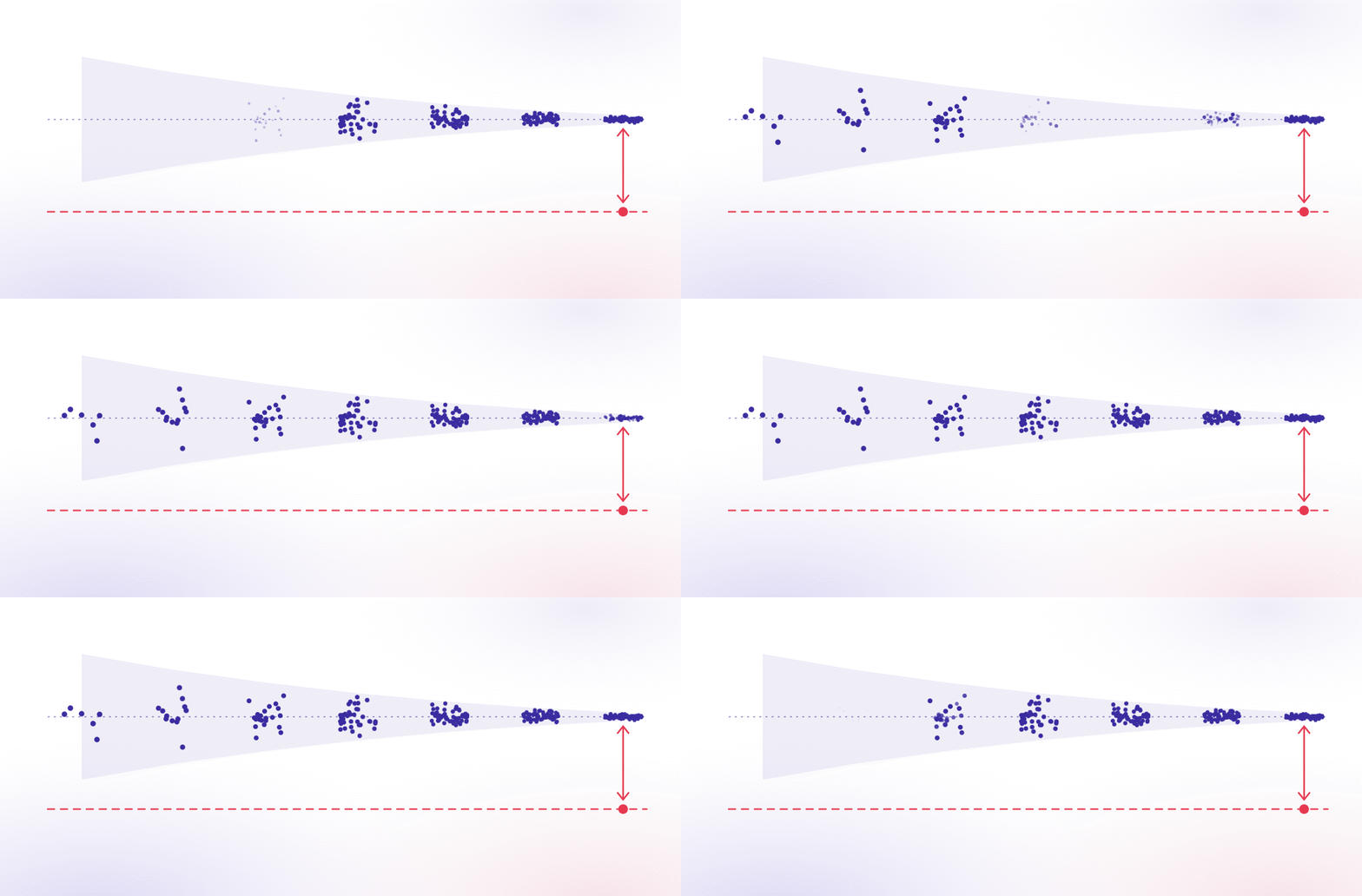
Scaling a biased model does not produce better representation. It produces higher-confidence bias.
What scales and what does not
Population-scale persona testing unlocks something genuinely new: the ability to detect AI failure modes statistically invisible at small scale. An AI that consistently misreads personas who combine high neuroticism with low income and minority cultural background, too rare to isolate at 7,290, becomes detectable at one million.
But that precision is only as valuable as the psychological validity of the personas used. An AI system certified as performing well against one million psychologically flawed personas does not arrive at deployment better tested, it arrives more confidently wrong.
-
The 2026 peer-reviewed study in Big Data & Society found that GPT-4o accurately reproduces the validated six-factor structure of human psychological needs, matching human study results across four countries. For values, the model captured mainstream patterns but systematically underrepresented perspectives tied to social transformation and minority worldviews, a structural bias in training data, not a model architecture flaw.
-
MatrAIx is a population-scale AI evaluation infrastructure published in August 2026 by researchers from Harvard, MIT, Stanford, and UC Berkeley. It creates synthetic persona agents from a 1,290-dimensional schema and pairs them with LLM backbones to simulate how diverse user populations interact with AI systems before deployment. A public coreset of approximately one million personas is available, drawn from a theoretical population of 8.3 billion.
-
No. MatrAIx's authors explicitly flag stereotype amplification and within-group flattening as persistent failure modes at scale. Because synthetic personas are generated by LLMs, they inherit the structural biases in those models' training data. Chulvi, Gonzalez, Fontanella & Rangels’ research confirmed this at 7,290 personas: scaling the same biased model produces more confident wrong answers, not better representation.