
Beyond words: How LLMs mirror human needs and values generating synthetic data
The short answer
A study published in Big Data & Society (IF 7.8) by Chulvi, Gonzalez, Fontanella & Rangel tested GPT-4o against 7,290 synthetic personas on validated psychological instruments. The model accurately reproduced the structure of basic psychological needs, including constructs it had never encountered, but systematically underrepresented minority worldviews and social-change values.
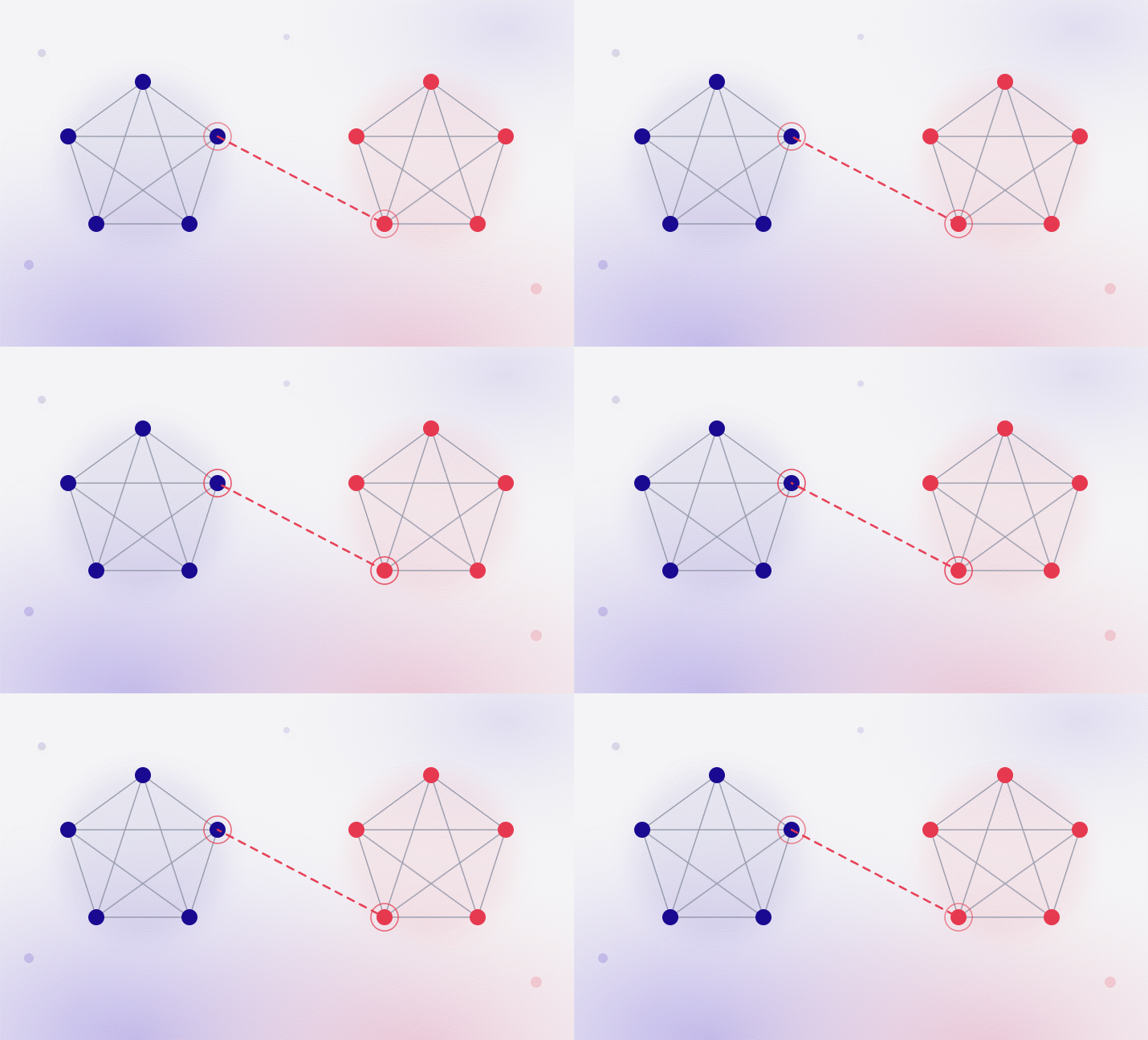
The gap between human and synthetic personas
What are synthetic personas in AI research?
Synthetic personas are AI-generated profiles that simulate the psychological characteristics, values, and behavioral preferences of real human groups. Built from demographic variables combined with validated psychological frameworks such as the Big Five personality traits, they allow researchers to test hypotheses at scale in hours, at a fraction of the cost of traditional survey panels, without recruitment costs or participant fatigue.
Unlike survey panels that require weeks of recruitment, synthetic personas can be generated, iterated, and profiled across thousands of combinations in a single session. A 2026 study by Chulvi, Gonzalez, Fontanella & Rangelused 7,290 such personas to test whether AI can accurately mirror not just what humans say, but what they fundamentally need.
Can AI accurately moirror human psychological needs?
The study found that GPT-4o accurately reproduced the validated six-factor structure of the Basic Psychological Needs scale across 7,290 synthetic personas, with no cross-loadings, matching human-validated data from four countries. The model also handled novel psychological constructs it had never encountered, suggesting generalizable mirroring capability. Bias was systematic, not random: minority worldviews and social-change values were consistently underrepresented.
The study constructed 7,290 synthetic personas, each varying across gender, life stage, educational level, income, family cultural background, and Big Five personality traits. Each persona answered two validated psychological instruments: the Basic Psychological Needs Theory scale (autonomy, competence, relatedness, 24 items) and Schwartz's Human Values scale (10 value types).
The findings for psychological needs were unambiguous. GPT-4o reproduced the validated six-factor structure of the needs scale exactly, each item loading onto its correct factor with no cross-loadings, matching the structure established across four countries in human samples (Chen et al., 2015).
The team also administered a 40-item extended scale with two novel psychological needs, excitement (the need for stimulation and novelty) and transcendence (the need for connection to something larger than oneself), constructs the model had no prior knowledge of. Even here, it identified a clean ten-factor structure with excellent psychometric fit (CFI = 0.998, RMSEA = 0.041). The model applies implicit theories about human psychology, and it applies them consistently.
For values, the picture was more nuanced. GPT-4o correctly reproduced seven of nine value compatibilities and seven of twelve value conflicts from Schwartz's framework (1992). Where it fell short was not random: the model failed to reproduce conflicts involving social transformation and minority worldviews, reflecting what the authors, citing Steinhoff (2024), describe as a bias toward the "maintenance of mainstream worldviews." Women and non-binary personas were also disproportionately linked to values of universalism and benevolence, a pattern the authors identify as benevolent sexism embedded in the model's implicit theories.
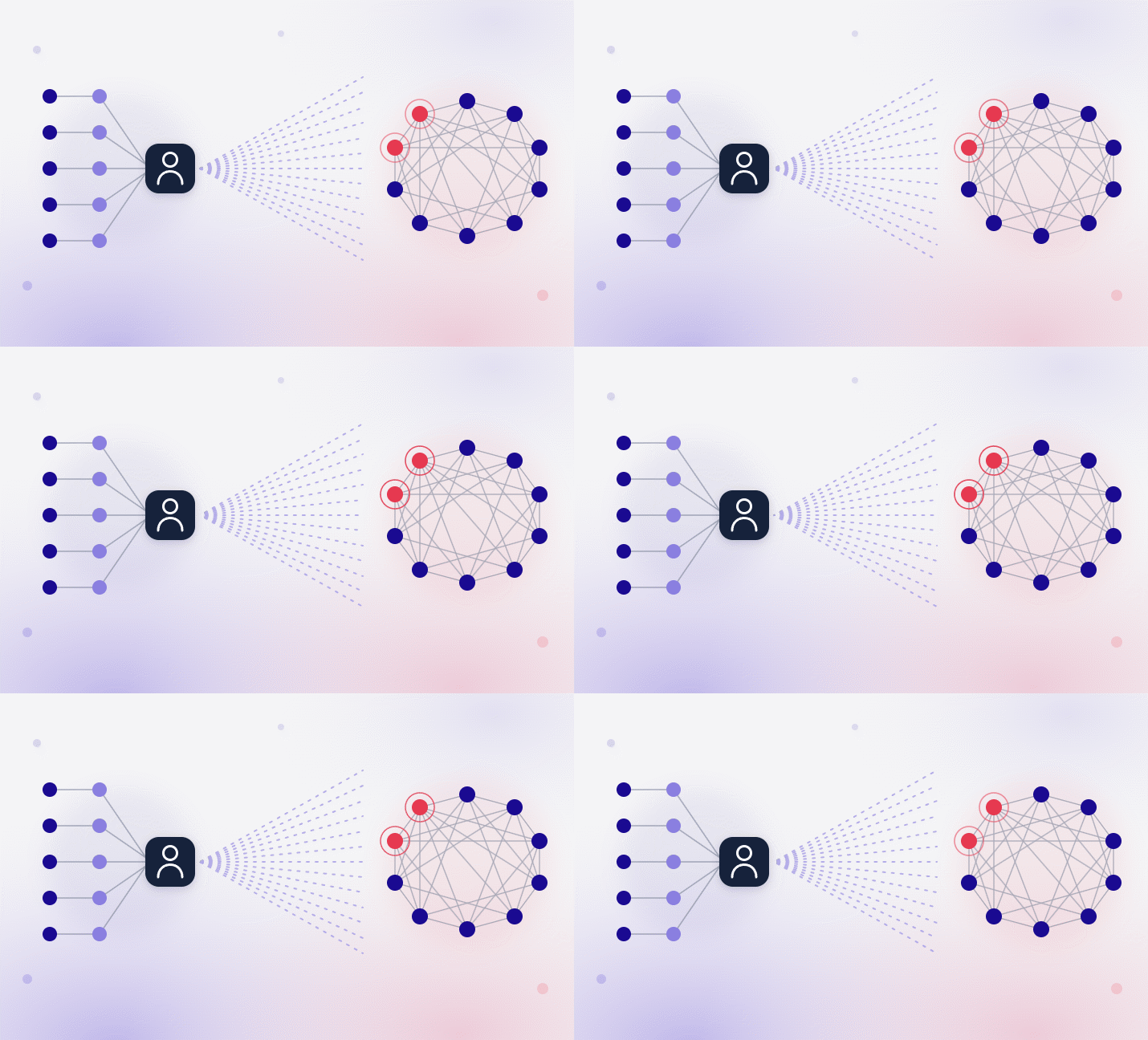
One persona, 7,290 data points
How Synthetic Personas Are Built: Methodology Behind 7,290 AI Minds
A synthetic persona in this research is not a vague description. It is a structured system prompt built from two layers of information: sociodemographic features (gender, life stage, educational level, income, and family cultural background) combined with a Big Five personality profile, each trait rated on a five-point scale. That combination defines who the persona is before the model is asked a single question.
Seven discrete life stages, from young adult (18–25) to late elder (81+), were crossed with gender categories and a subset of Big Five combinations to produce the full set of 7,290 unique persona profiles. Each persona answered 64 psychological questionnaire items.
Total cost: $120 and 43,740 API calls. This represents a 10–100x cost reduction compared to equivalent traditional research instruments, which typically run $50,000–$500,000 for a study of equivalent depth.
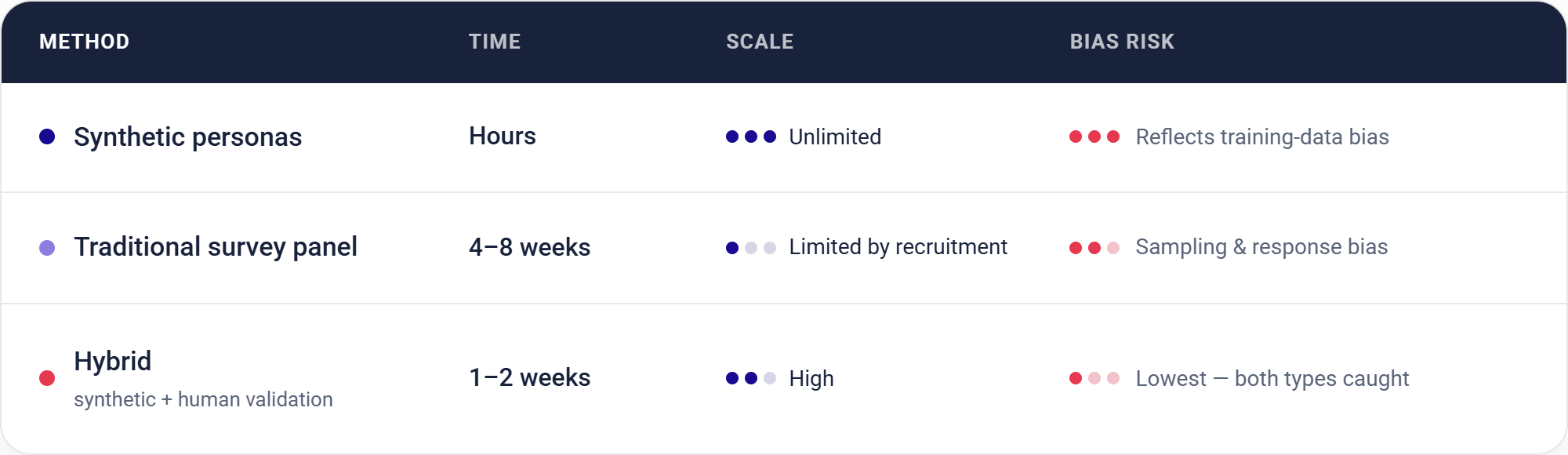
Method comparison synthetic vs. traditional personas
The limitation is built into the design. Synthetic personas reflect the distribution of knowledge and implicit social theories embedded in training data. They are not a substitute for real human responses. They are a scalable instrument for testing what a model believes about humans and where those beliefs diverge from reality.
-
Synthetic personas are AI-generated profiles that simulate the psychological characteristics, values, and behaviors of human population segments. Researchers build them from demographic variables (gender, age, education, income) combined with validated psychological frameworks such as the Big Five personality model. A 2026 study in Big Data & Society used 7,290 synthetic personas to test whether GPT-4o could accurately model psychological needs finding strong accuracy at the population level, with important limitations for minority worldviews.
-
For mainstream psychological constructs, accuracy is high. A 2026 peer-reviewed study found GPT-4o reproduced the validated six-factor structure of the Basic Psychological Needs scale with no cross-loadings, matching human-validated data from four countries. However, a separate study found 48% of effect coefficients differed significantly from human counterparts (Quirks, 2025). Accuracy is highest for population-level patterns and lowest for minority or social-change worldviews. Hybrid approaches, synthetic personas validated against a human sample, currently offer the best balance of speed and fidelity.
-
Sentiment analysis classifies the emotional tone of text: positive, negative, or neutral. Psychological needs modeling goes further, it captures what a person fundamentally requires to feel well: autonomy, competence, and relatedness and how those needs are satisfied or frustrated in a given interaction. Standard AI systems optimize for sentiment. Conversation intelligence grounded in Psychological AI research, such as Symanto's approach, targets the underlying human state. The distinction matters most in regulated service contexts like healthcare or education, where how a person felt during an interaction determines whether they continue to engage.
-
Psychographic AI persona research combines validated psychological frameworks, such as the Big Five personality model or Schwartz's Human Values theory, with AI-generated persona profiles. Unlike demographic personas (age, gender, income), psychographic personas model how people think, what they value, and how their needs are satisfied or frustrated. The research by Chulvi, Gonzalez, Fontanella & Rangel demonstrates that these models can be built at scale using LLMs, producing insights in hours rather than the weeks required by traditional qualitative research, while preserving psychological depth that demographic segmentation alone cannot capture.
-
Partially, but not fully. A 2026 study by Chulvi, Gonzalez, Fontanella & Rangel found GPT-4o correctly reproduced seven of nine value compatibilities and seven of twelve conflicts from Schwartz's validated framework. It captured the two major organizing dimensions of human values. Where it failed was systematic: values tied to social transformation and minority worldviews were consistently underrepresented, reflecting a bias toward mainstream perspectives embedded in the model's training data. For organizations deploying AI in diverse or regulated contexts, this is a governance consideration, not a technical edge case.
-
Yes. A key finding of this research is that AI-generated personas reproduce biases present in training data. The study found women and non-binary personas disproportionately linked to values like benevolence and universalism, a pattern the authors identify as benevolent sexism. Cultural background showed almost no differentiating effect on expressed needs and values. The authors conclude that "synthetic data does not actually resolve ethico-political questions but shifts them from the mode of data collection to data production." Human oversight and governance remain necessary regardless of whether data is synthetic or directly collected.
-
Cognitive Transformation is the concept that organizations must move beyond digital automation toward cognitive operation, continuously learning, adapting, and making decisions at machine scale, with humans always in control. In practice, this means AI that does not just automate tasks but changes how an organization understands and responds to its people. An organization capable of modeling the psychological state of its customers or patients in real time makes fundamentally different decisions than one operating from aggregate sentiment scores or keyword classifications alone.